Выпуск
DMA#44: Funding the Absurdity: How to Pay for Ink Without Selling Your Organs with Mason Currey
Draw Me Anything with Jason Chatfield · 14 апреля 2026 г. · 56 мин
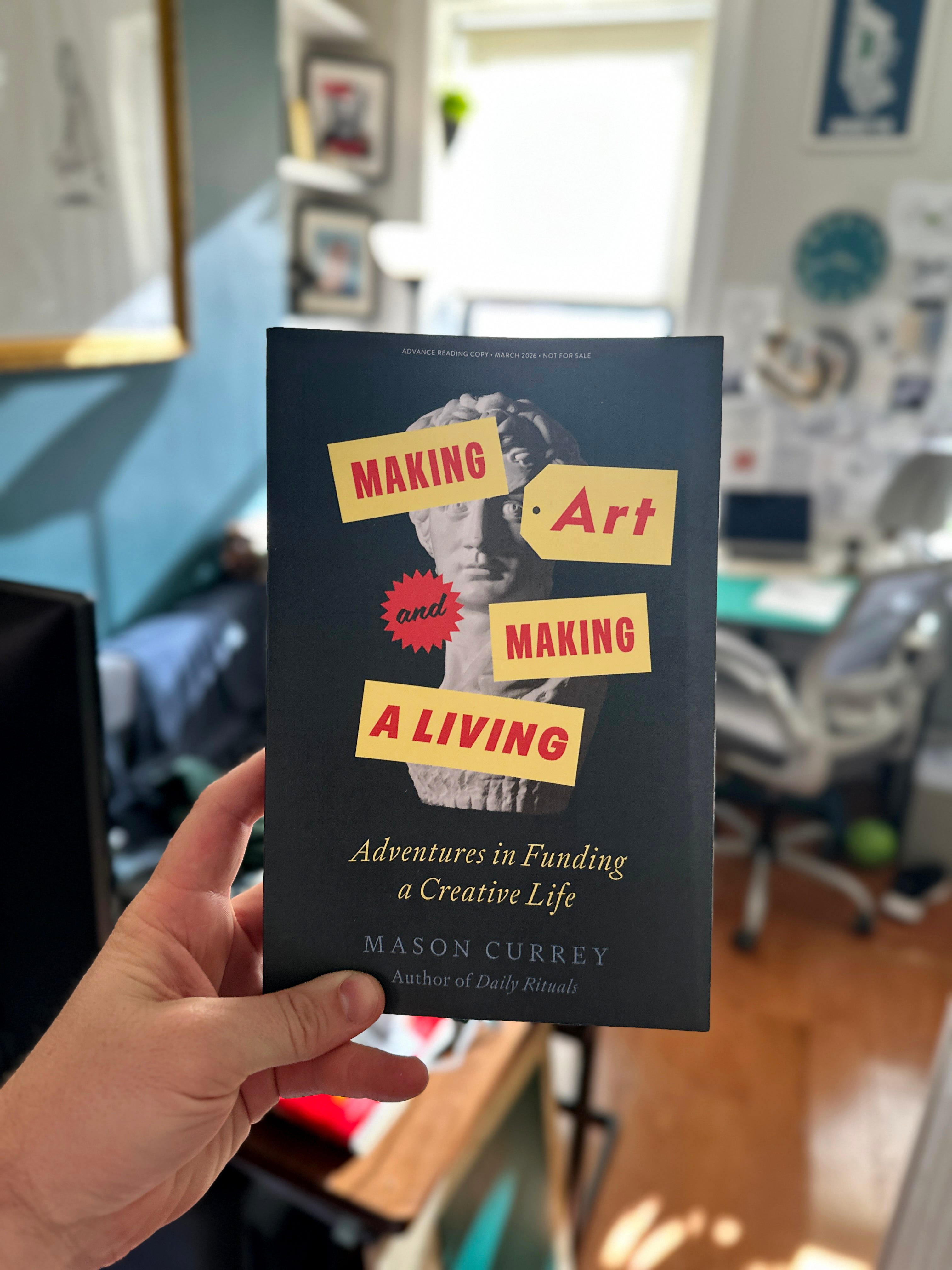
I live in an ancient little apartment a block from Times Square, because I love cooking dinner in my bedroom. It’s more of a ‘Pre-War Cupboard’ really. I ordered a mini fridge the other day because I needed a guest bedroom. Morris, my French bulldog, is asleep on a pile of discarded drawing paper, completely unbothered by the fact that his gourmet kibble requires legal tender. My radiator clangs with the aggressive rhythm of a stolen Citibike being dragged backwards down a flight of subway stairs. It’s a very particular kind of anxiety. You want to make art, but you also want to occasionally eat a Chipotle burrito (strictly no beans). It’s an impossible Venn diagram. I’ve made my living for twenty-one years as a freelance artist and comedian. I don’t have a day job, I don’t have a side hustle, and I don’t have a wealthy patron bankrolling my Blackwing addiction. Luckily, Mason Currey came on the show this week. He’s the author of Daily Rituals , a book I devoured during the pandemic, and his new hardcover is out right now. It’s called Making Art and Making a Living: Adventures in Funding a Creative Life . When I first saw the title, I told Mason my immediate thought process. “I initially, when I got the book, thought it was finding a creative life,” I said. “And I was like, oh no, it’s way more important. Funding ! It’s about money.” We got into the weeds of how historical geniuses paid their bills, and honestly, it’s comforting to realise they were mostly just flailing around like the rest of us. I started by asking about Arthur Schopenhauer, who managed to dodge a soul-crushing life in mercantile finance solely because his father died and left him an inheritance. I spend half my time wandering the concrete canyons of Manhattan, wondering how to pay my rent, so I had to ask Mason: Is the secret to artistic genius really just having a rich dad who dies at the exact right time? “James Joyce, for instance, was an absolute nightmare of a human being…” It turns out, the answer is a complicated ‘yes and no’. We discussed Charles Baudelaire, whose letters to his mother sounded violently familiar. I’ve always carried this quiet, crushing shame that I can’t just sit at a desk at 9:00am and produce brilliance. I struggle with regulating attention on demand and initiating tasks without a heroic amount of friction. When I can’t meet expectations, it feels intensely personal, like a reflection of who I am at my core. I asked Mason if Baudelaire’s legendary financial chaos was a symptom of executive dysfunction. Mason pointed out that Baudelaire would let pressure build up until he was in a mad panic. “He talks about how he can’t make himself do the thing until it’s built up so much pressure that he finally does it in this explosion,” Mason said. “He sort of had run up so much debt that he’s forced to dodge creditors and continually be moving from place to place.” If you enjoy my work and would like to support, please take out a premium subscription (just $1 per week) Leaving things until the absolute last second to manufacture adrenaline is a textbook symptom of ADHD. B