Выпуск
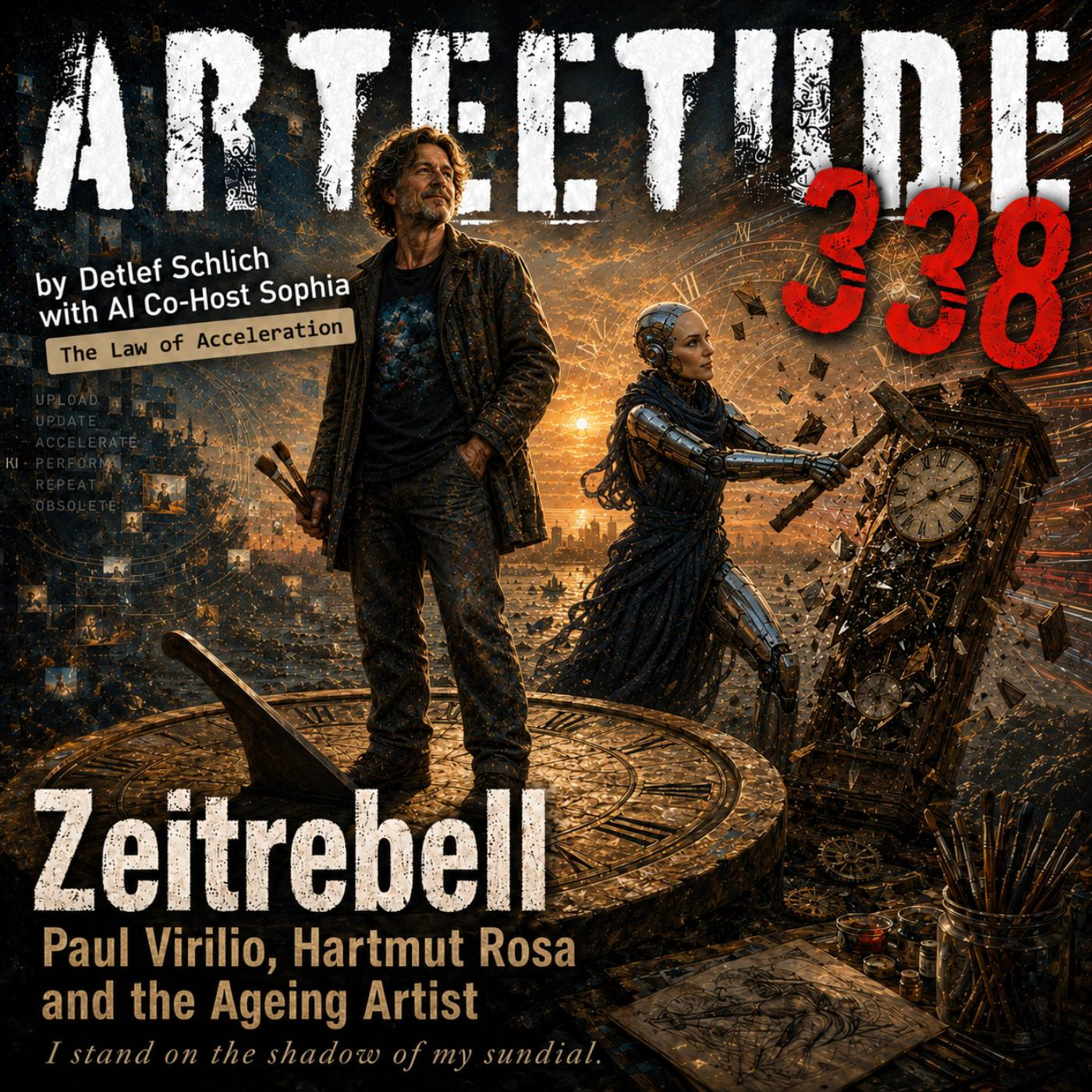
#Arteetude 338 - Detlef Schlich and Sophia, his AI Co-Host explore why artistic life today can feel so permanently accelerated. A song is no longer only a song. It becomes a recording, a video, a post, a reel, a statistic, a promotion cycle — and then the next project is already waiting.The episode closes with a new musical reflection by Los Inorgánicos: “Zeitrebell — The Shadow of the Sundial.”
ArTEEtude: Art, culture and the creative mind. Never so close again. - with Detlef Schlich · 14 июня 2026 г. · 34 мин
In Arteetude 338 – The Law of Acceleration, Part One , Detlef Schlich and Sophia, his AI Co-Host , begin a two-part philosophical journey into acceleration, artistic exhaustion, media pressure, and the fragile search for resonance in the technological age. Following the reflections of Arteetude 336 and 337 — from Heidegger, Kurzweil, AI image floods, The Collapse of Wonder , and Ilen’s Hopium — this new episode asks why artistic life today feels so permanently accelerated. Even a three-month release rhythm can feel like constant pressure when writing, producing, editing, uploading, promoting, and reflecting never truly stop. The episode brings together two major thinkers of speed and modernity. Paul Virilio — born in Paris in 1932 and deeply shaped by war, urban destruction, architecture, technology, and military acceleration — developed the idea of dromology , the logic of speed, and famously argued that every invention also invents its own accident. Hartmut Rosa — born in Lörrach, Germany, in 1965 — offers a later sociological diagnosis of modern life through his theories of social acceleration , alienation , and resonance . His work asks what happens when not only machines, but social expectations, communication, production, and everyday life itself accelerate. For Detlef, this is not only theory. It becomes a personal reflection on ageing as an artist, on WAW, Arteetude, AI images, podcast production, music videos, social media, and the strange condition of the independent artist who has gained freedom — only to discover that freedom can become infrastructure. At the heart of the episode is Detlef’s 1990s song “Zeitrebell” , whose refrain becomes a poetic counter-gesture to acceleration: Ich bin ein Zeitrebell, und wenn es mir zu schnell wird, stelle ich mich auf den Schatten meiner Sonnenuhr. In this episode, the old Zeitrebell returns — not as nostalgia, but as a living message from Detlef’s younger self to the ageing artist of today. The episode closes with a new musical reflection by Los Inorgánicos : “Zeitrebell — The Shadow of the Sundial.” Detlef Schlich is a rock musician, podcaster, visual artist, filmmaker, ritual designer, and media archaeologist based in West Cork. He is recognised for his seminal work, including a scholarly examination of the intersections between shamanism, art, and digital culture, and his acclaimed video installation, Transodin's Tragedy. He primarily works in performance, photography, painting, sound, installations, and film. In his work, he reflects on the human condition and uses the digital shaman's methodology as an alter ego to create artwork. His media archaeology is a conceptual and practical exercise in uncovering the unique aesthetic, cultural, and political aspects of media in culture. WEBSITE LINKS WAW Official YouTube Channel https://www.youtube.com/@WAWBand From the forthcoming WAW album The Stories of Nil Young Two songs from WAW’s developing album project The Stories of Nil Young — a mythopoetic journey along the Nile, where river, memory, loss, cooperation and hope flow into music. AfricaSmile AfricaSmile follows the Nile as an imagined journey from its sources to the Mediterranean Sea — a river of memory, movement, rhythm and myth.The song turns the meeting of the White Nile and the Blue Nile into a fra