Выпуск
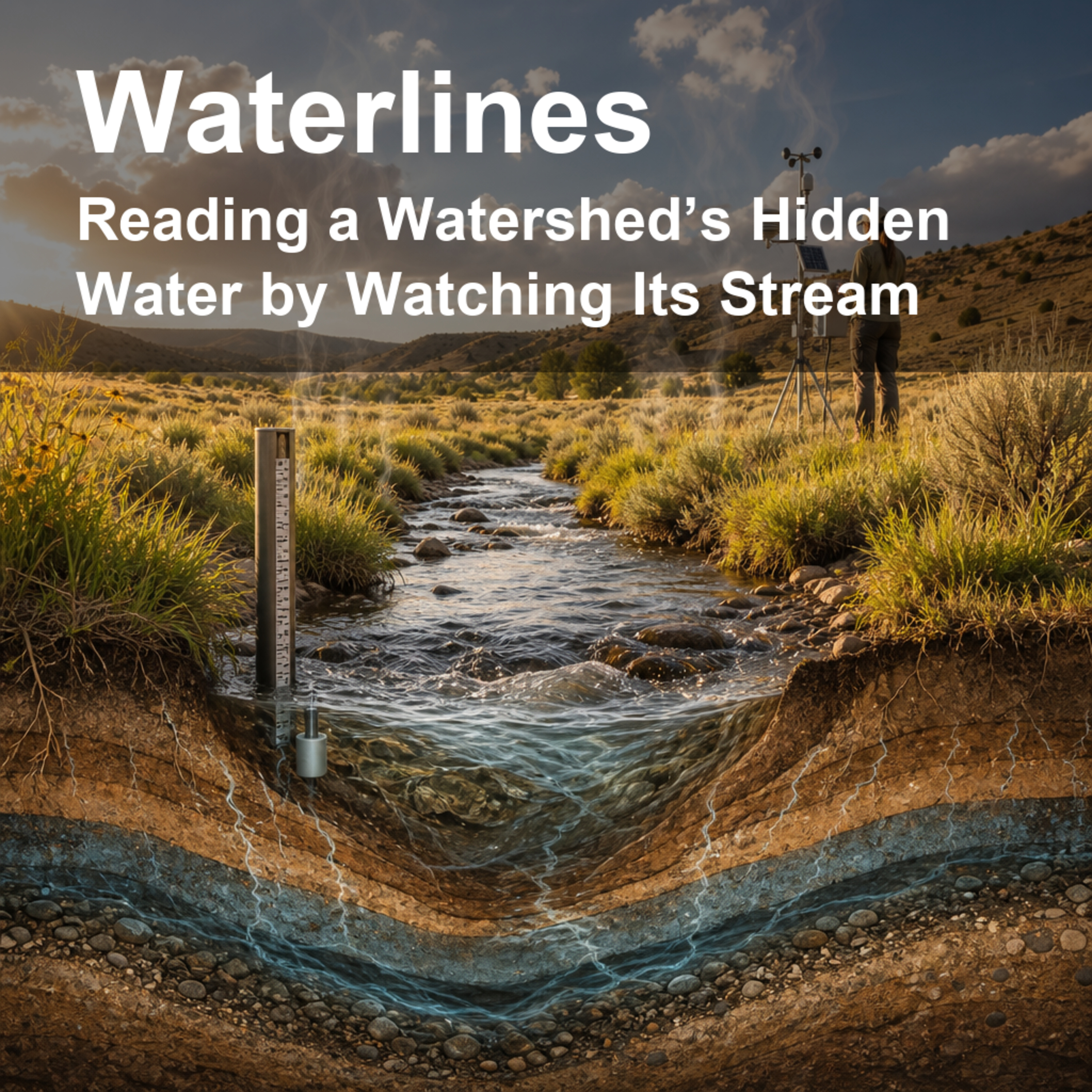
Reading a Watershed’s Hidden Water by Watching Its Stream
Waterlines: How Water Shapes Our World · 16 сентября 2026 г. · 11 мин
Takeaway: A stream can tell us about more than runoff; its rises and falls can help reveal how much hidden water the whole watershed is losing to the air. Every water plan depends on a hard-to-see number: how much water leaves the land not as streamflow, but as invisible vapor from soil, leaves, grass, crops, and forests. That loss, evapotranspiration, shapes drought, irrigation demand, ecosystem stress, and climate feedbacks—but direct measurements are scarce. This episode follows a clever attempt to estimate that invisible water use with records many places already have: rain, streamflow, and basic weather data. Hosts unpack how Tuttle and Salvucci built a simple watershed-scale model around one practical idea: a wetter watershed should usually have both more streamflow and more efficient evaporation and plant water use. By integrating a water balance through time, the model infers storage—the hidden water held in soils, shallow groundwater, surface water, and vegetation—and then chooses its key parameter by finding when inferred storage best lines up with observed streamflow. Tested across nine U.S. watersheds linked to AmeriFlux sites, the model often tracked measured daily evapotranspiration well, especially in arid and semiarid places where water availability strongly controls plant and soil water loss. We also talk about the caution flags: humid watersheds can be more energy-limited than water-limited, a single flux tower may not represent a whole basin, stream gauges and rain records have errors, and dams, irrigation, crops, lawns, and groundwater movement can complicate the story. The result is not a magic water meter, but a useful example of how hydrologists squeeze insight from everyday observations. Citation: Tuttle, S. E., and G. D. Salvucci (2012), A new method for calibrating a simple, watershed-scale model of evapotranspiration: Maximizing the correlation between observed streamflow and model-inferred storage, Water Resources Research, 48, W05556, doi:10.1029/2011WR011189. Disclosure: This Waterlines episode package is written for production with AI-generated voices.