Выпуск
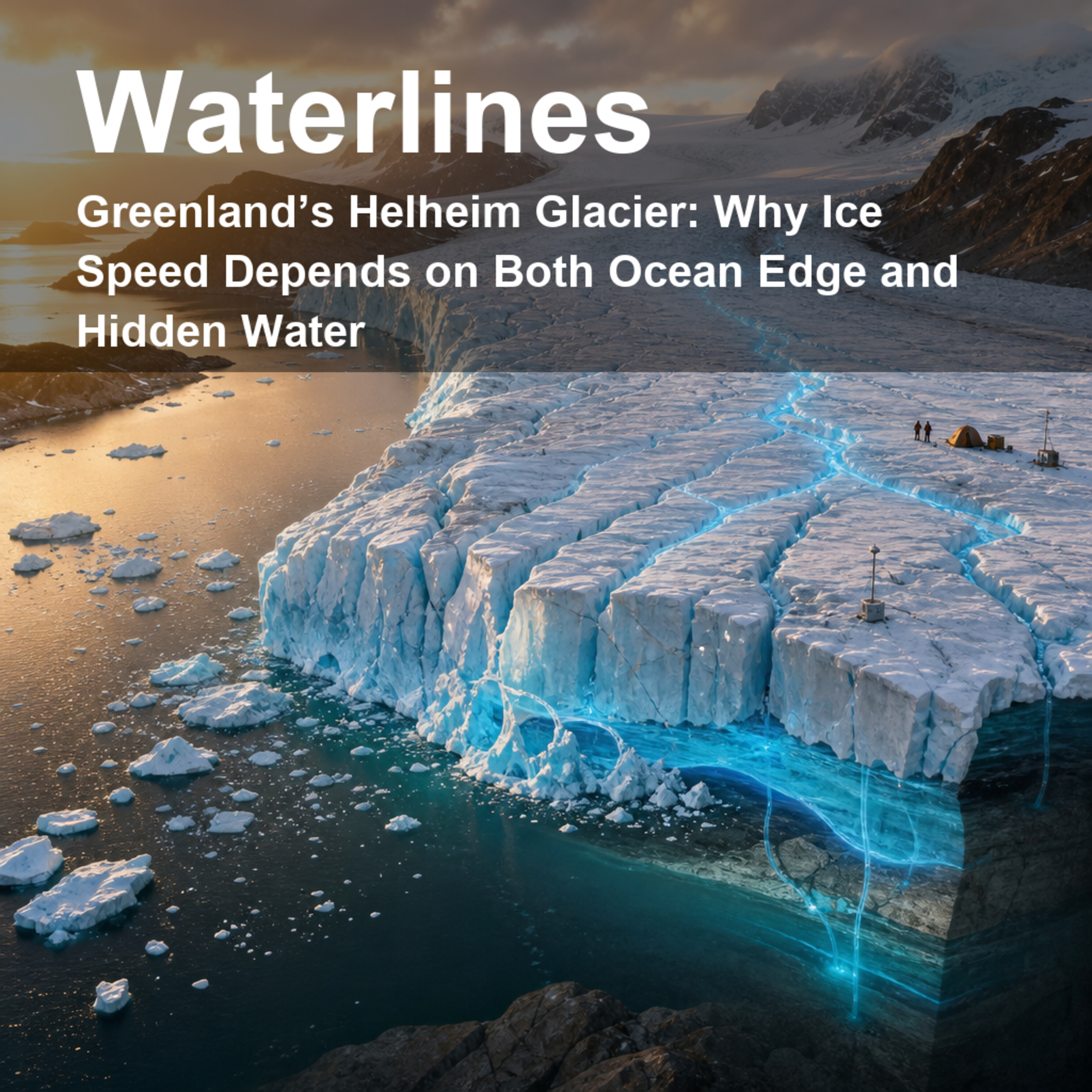
Greenland’s Helheim Glacier: Why Ice Speed Depends on Both Ocean Edge and Hidden Water
Waterlines: How Water Shapes Our World · 21 октября 2026 г. · 9 мин
Takeaway: Helheim Glacier is steered by its ocean front near the coast, but farther inland the hidden water under the ice can take the wheel. Greenland’s outlet glaciers matter far beyond the Arctic because they help set the pace of sea-level rise, and that pace depends on something surprisingly everyday: where water goes. This episode follows new modeling work on Helheim Glacier, a fast-moving glacier that drains into the ocean in southeast Greenland. The study asks a deceptively simple question: when the glacier speeds up or slows down, is it mostly reacting to what happens at its ocean-facing front, or to meltwater slipping underneath the ice like water under a heavy sled? We unpack how the researchers coupled an ice-flow model with a subglacial water model to let ice motion and hidden drainage influence each other. Their result is not an either-or answer. Near the terminus, where the glacier meets the fjord, ocean-edge effects dominate speed changes for about 15 kilometers inland. Farther upstream, seasonal meltwater at the bed becomes the stronger control. In a warmer future with more melt reaching higher inland areas, that hidden plumbing could matter more for how much ice Greenland sends to the sea. Citation: Sommers, A. N., Meyer, C. R., Poinar, K., Mejia, J., Morlighem, M., Rajaram, H., Warburton, K. L. P., & Chu, W. (2024). Velocity of Greenland's Helheim Glacier controlled both by terminus effects and subglacial hydrology with distinct realms of influence. Geophysical Research Letters, 51, e2024GL109168. https://doi.org/10.1029/2024GL109168 Disclosure: This episode uses AI-generated voices.