Выпуск
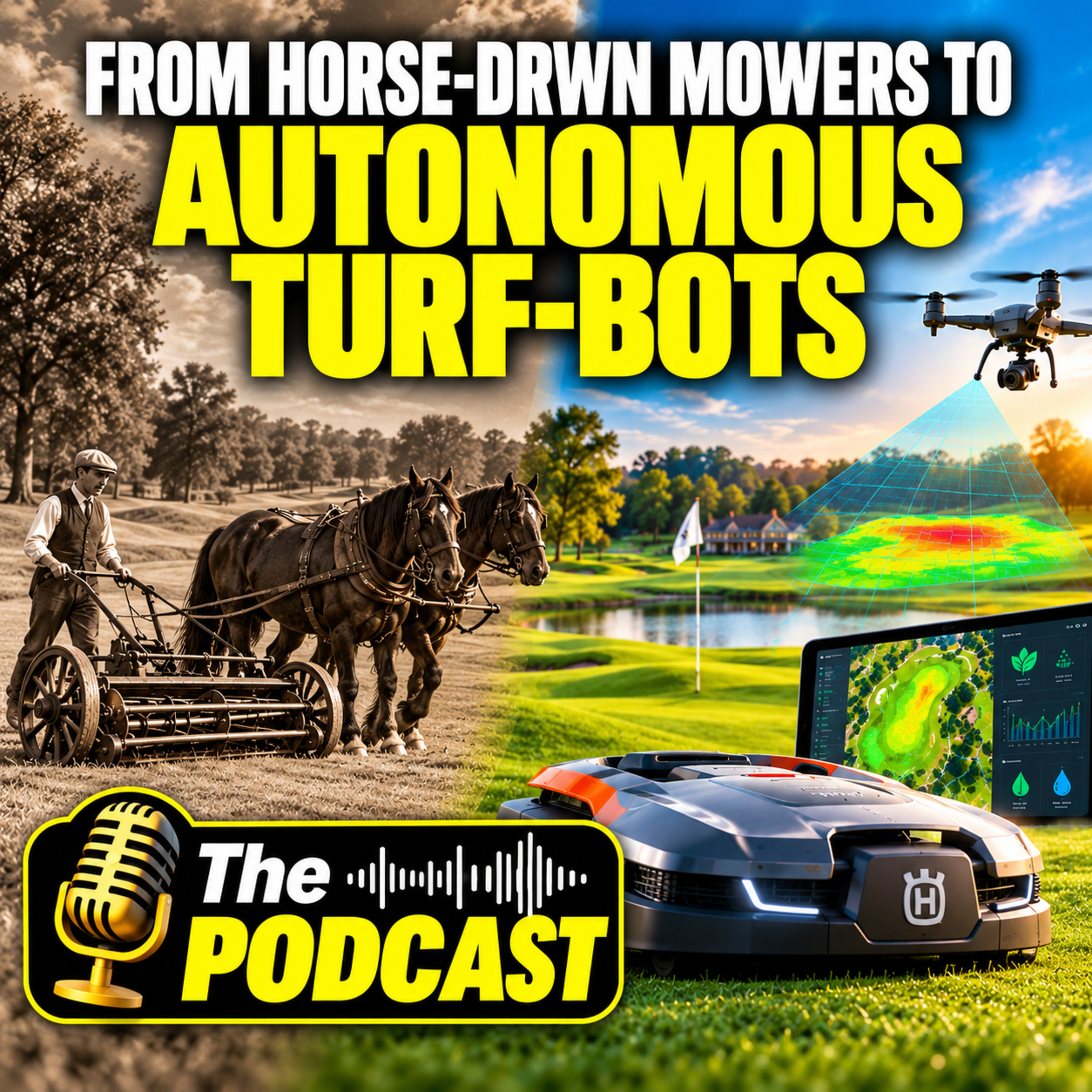
#750 From Horse-Drawn Mowers to Autonomous Turf-Bots: 5 Breakthroughs in Golf Course Care
eCoach360°: The Global Platform for Innovative Technologies and Teaching Concepts. · 25 октября 2026 г. · 23 мин
Golf course maintenance has evolved from manual tools and horse-drawn equipment to electric mowers, autonomous robots, drones, and intelligent irrigation systems. Here are five breakthroughs that changed greenkeeping. 1. Electric Mowers Existed in 1928 In 1830, Edwin B. Budding invented the mechanical reel mower, adapting technology used to cut textiles. Motorized greensmowers followed in the early 20th century. Surprisingly, Toro experimented with an electric greensmower in 1928. But its trailing power cable made it impractical for large golf courses. Modern lithium-ion batteries finally solved that problem. Toro introduced the Greensmaster eFlex in 2012, followed by the fully electric eTriFlex in 2019. Electric mowing reduces noise and direct emissions. Some designs also prevent hydraulic oil leaks on greens. 2. Faster Mowing Created the Triplex Ring Ride-on triplex greensmowers transformed maintenance in the late 1960s. Three cutting reels allowed greenkeepers to cover putting surfaces much faster. But the heavier machines created an unexpected problem: repeated tight turns around green perimeters could damage grass and compact soil. The resulting band of stressed turf became known as the Triplex Ring. Modern equipment and mowing practices aim to reduce turning stress, protect rootzones, and maintain healthy grass. 3. Robots Are Already Mowing Tournament Courses At the 2024 U.S. Amateur Four-Ball Championship, Husqvarna robotic mowers helped maintain the rough. Today's autonomous machines can use satellite positioning and virtual boundaries instead of buried wires. They follow programmed mowing patterns, return for charging, and transmit operating information to cloud-based management systems. This lets teams focus on bunkers, green conditioning, and turf health. 4. Drones and Sensors Reveal Hidden Turf Problems Modern golf maintenance increasingly resembles precision agriculture. Drones with multispectral cameras can identify variations in vegetation health, helping greenkeepers investigate potential drought, disease, or nutrient problems. LiDAR can map terrain and highlight possible drainage issues. Underground sensors measure soil moisture and temperature, while advanced irrigation software helps adjust watering to actual conditions. Camera-guided sprayers can target weeds rather than treating entire areas unnecessarily. This saves water, labor, and resources. 5. Robots Could Reshape Golf Course Design By 2030, autonomous equipment may influence how new golf courses are planned. Architects could incorporate wider turning areas, charging stations, accessible maintenance corridors, and terrain suited to robotic machines. Imagine autonomous mowers working overnight while soil sensors monitor moisture and irrigation systems respond to changing conditions. Greenkeepers would remain essential, focusing more on agronomy and technology. Conclusion Golf course care has progressed from hand tools and horse-drawn rollers to battery-powered machinery, satellite-guided robots, and intelligent sensor networks. The goal remains the same: healthier turf, consistent playing conditions, and a better golfing experience. The next revolution in golf might not happen in the player's swing. It could be happening silently beneath their feet. My Blog The Explainer