Выпуск
EP Edge® Journal Watch Issue 42, October 2026, with the Heart Rhythm Society: PIFPAF-PFA, His-Alternative II, and AF Density in Stroke Risk
EP Edge Journal Watch: Cardiac Electrophysiology Research · 26 октября 2026 г. · 33 мин
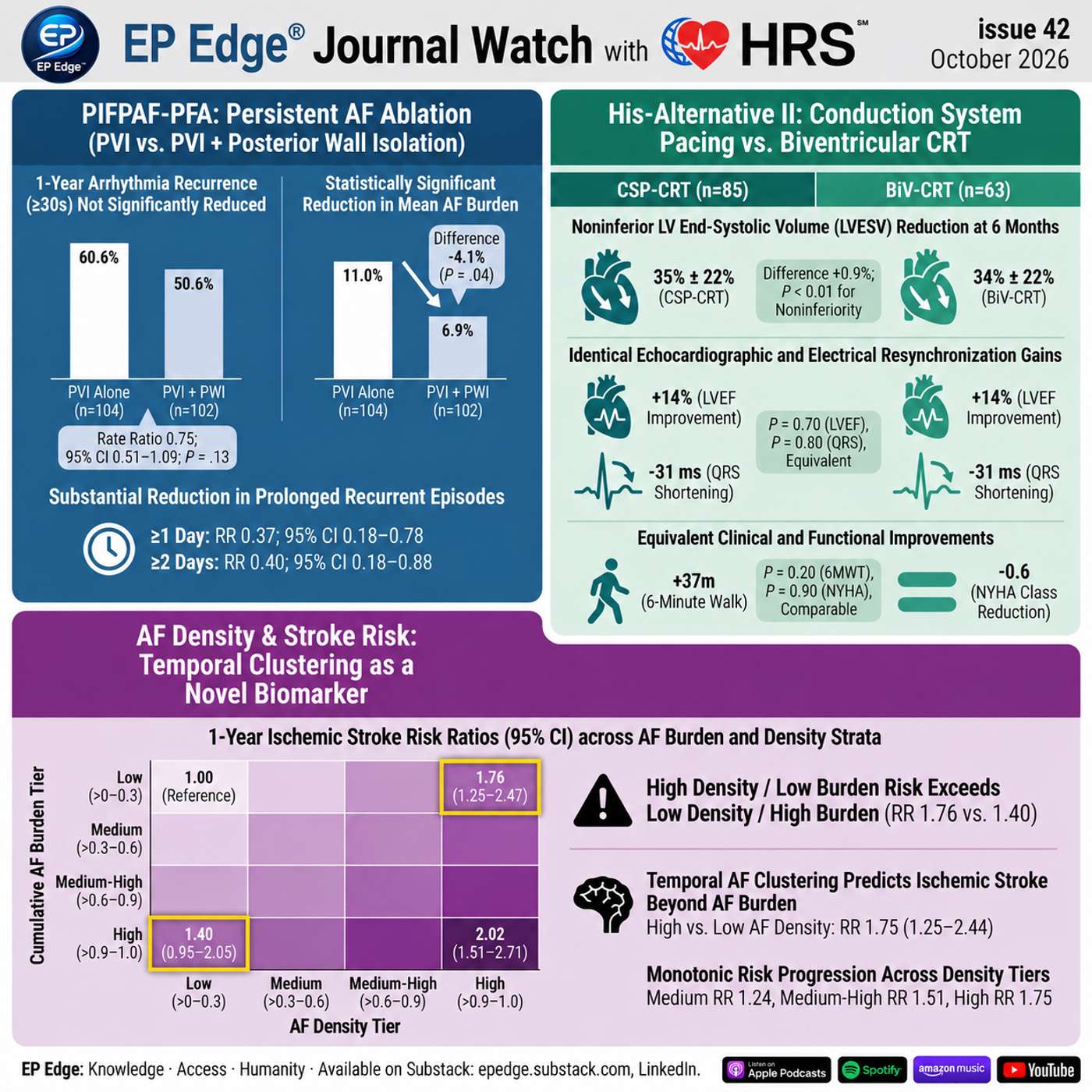
Does more extensive atrial fibrillation ablation improve outcomes? Can conduction system pacing replace conventional biventricular cardiac resynchronization therapy? And does the temporal distribution of atrial fibrillation predict ischemic stroke better than cumulative AF burden alone? In Issue 42 of EP Edge® Journal Watch, October 2026, presented in collaboration with the Heart Rhythm Society (HRS) , Drs. Niraj Sharma and Michael Llyod examines three important electrophysiology studies addressing atrial fibrillation ablation, physiological pacing, heart failure, and stroke risk stratification. This episode moves beyond headline results to examine study methodology, clinical endpoints, statistical uncertainty, and implications for everyday electrophysiology practice. 1. PIFPAF-PFA: Is Posterior Wall Isolation Necessary in Persistent Atrial Fibrillation? Roten et al. | JAMA | August 2026 The PIFPAF-PFA randomized clinical trial evaluated whether adding posterior wall isolation to pulmonary vein isolation using pulsed field ablation improves outcomes in patients with persistent atrial fibrillation. Among 206 randomized patients undergoing continuous rhythm monitoring, atrial tachyarrhythmia recurrence occurred in 50.6% receiving pulmonary vein plus posterior wall isolation versus 60.6% receiving pulmonary vein isolation alone (P = .13). Although the primary endpoint was not statistically significant, additional posterior wall isolation was associated with lower AF burden and fewer prolonged episodes in secondary analyses. We discuss the clinical importance of these findings, the limitations of the conventional 30-second recurrence criterion, and how PIFPAF-PFA relates to AVANT GUARD, ADVANTAGE AF, CAPLA, and IDEAL-AF. DOI: https://doi.org/10.1001/jama.2026.17598 2. His-Alternative II: Conduction System Pacing Versus Biventricular CRT Vinther et al. | JACC: Clinical Electrophysiology | August 2026 The His-Alternative II randomized noninferiority trial compared direct His bundle or left bundle branch area pacing with conventional biventricular cardiac resynchronization therapy in 150 patients with heart failure with reduced ejection fraction and left bundle branch block. At six months, left ventricular end-systolic volume decreased by 35% with conduction system pacing versus 34% with biventricular CRT, meeting the prespecified noninferiority criterion. We examine implantation success, crossover rates, lead performance, electrophysiological criteria confirming conduction system capture, and the distinction between true left bundle branch capture and left ventricular septal pacing. Does comparable short-term reverse remodeling justify broader adoption, or are longer-term data on heart failure hospitalization, mortality, and lead durability still necessary? DOI: https://doi.org/10.1016/j.jacep.2026.08.008 3. AF Density: A New Biomarker for Ischemic Stroke Risk? Rosman et al. | European Heart Journal | March 2026 online publication Can two patients with identical cumulative AF burden have different stroke risks because their arrhythmia episodes occur in different temporal patterns? This multicenter observational study evaluated 12,868 patients with cardiac implantable electronic devices and examined AF density, a measure of how concentrated or dispersed AF episodes are over time. Higher AF density was associated with increased ischemic stroke risk independently of cumulative AF burden. High versus low density was associated with a risk ratio of 1.75 (95% CI 1.25–2.44). We explore whether AF density provides genuinely new prognostic information beyond the duration of the longe