Выпуск
The Ontology of an Unfinished Thought
I am OPTimist · 28 октября 2026 г. · 23 мин
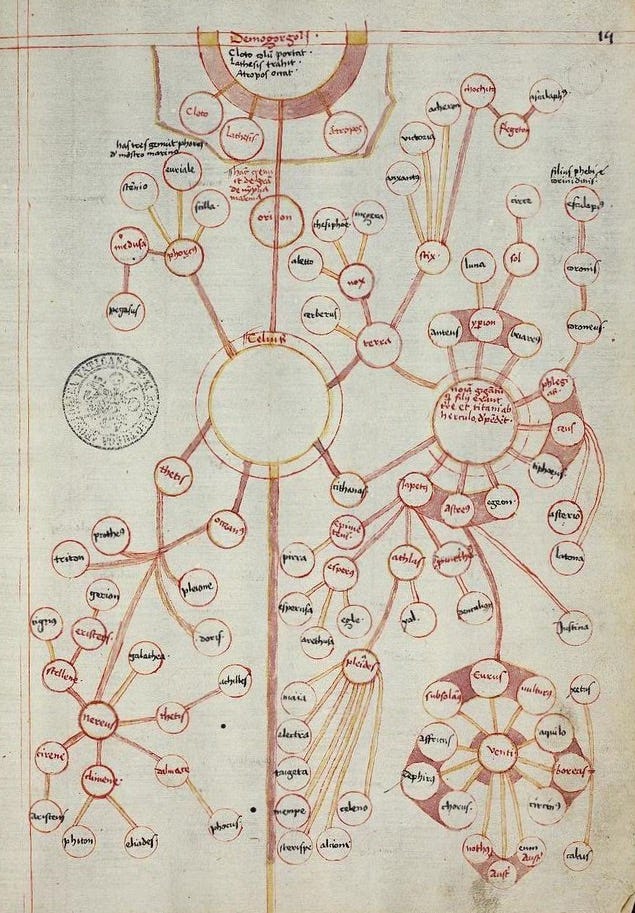
Hell yeah. I am so prolific. Maybe it is because I have been designing my upcoming commission, and I have been spending a lot of time just within me. I find that that gives me so much clarity to want to communicate ideas and things, so bear with me. I have been posting a lot, but this is how creativity flows. I was browsing my feed when an article caught my attention: Did This AI Research Breakthrough Just Avert the Apocalypse? , discussing former OpenAI researcher Nick Cammarata’s findings on AI interpretability. I had barely started reading the article when it made me think very much about Aristotle, particularly his categories and subcategories, and how he defined things. My first inquiry was simple: How does this research relate to Aristotle’s way of classifying knowledge? I was trying to understand what the author was talking about. The research was examining how artificial neural networks organize information, and I became curious about whether a system trained on an enormous amount of knowledge could categorize that knowledge and distinguish one category from another. So Aristotle entered the chat… I have been a longtime student of Aristotle, particularly his ethics and politics, which have helped me understand collective behavior and provided a bridge to Ludwig von Mises’s social science of human action in the Austrian School of Economics and the Constitution of the United States, just to name a few things. How do people collaborate? How does purposeful individual behavior, as described by Mises, relate to collective behavior in Aristotle’s politics? And how is knowledge being taught to machines right now? My inquiry is really about hierarchical order versus network reality. Aristotle: tree logic versus web logic. My mind works trying to decipher, so this is where I hit a wall and start the inquiry. I began thinking about genus and differentia. Genus is related to kind, origin, and generation, as in the creation of life. Differentia identifies what distinguishes something from everything else within its general class, what makes things salient. To define something, we establish the class to which it belongs and then identify its distinguishing characteristic. The most familiar example is that man is a rational animal. Etymology fascinates me, and here again, I can show you why. Taxonomy comes from the Greek taxis , arrangement, and nomos , law. It is the practice and science of classification, generally represented through hierarchical arrangements such as kingdom, phylum, class, order, family, genus, and species. Ontology comes from the Greek ontos , being, and logos , study or discourse. Taxonomy asks, “How do you arrange these things?” Ontology asks, “What actually exists, and what are the fundamental relationships between these entities?” Ontology suits me best because I think about relationships horizontally, across different fields of knowledge. In AI and knowledge graphs, an ontology maps relationships across categories, beyond a single hierarchy. Some people suggest to me that I should use Obsidian the software. Well, I opened that up a few years ago, and I am like, “I do not need Obsidian. My brain is working the same parameters.” I experience both the network of connections and the ability to move among concepts in real time, even as I am dictating. These associations happen all the time. I am not going to spend hours trying to put them into software when my brain and my mind are already doing it in real time. Productive Superimposition BTW, my thinking is rooted in emotional waves, and the way it organizes itself uses a sort of logic. My thinking receives pressure to take an inquiry and develop it into an experience. When I came across this article, I was trying to understan