Выпуск
2.6 Sigma: Super-Kamiokande’s First Indication of Ancient Supernova Neutrinos
Multi-messenger astrophysics · 30 октября 2026 г. · 23 мин
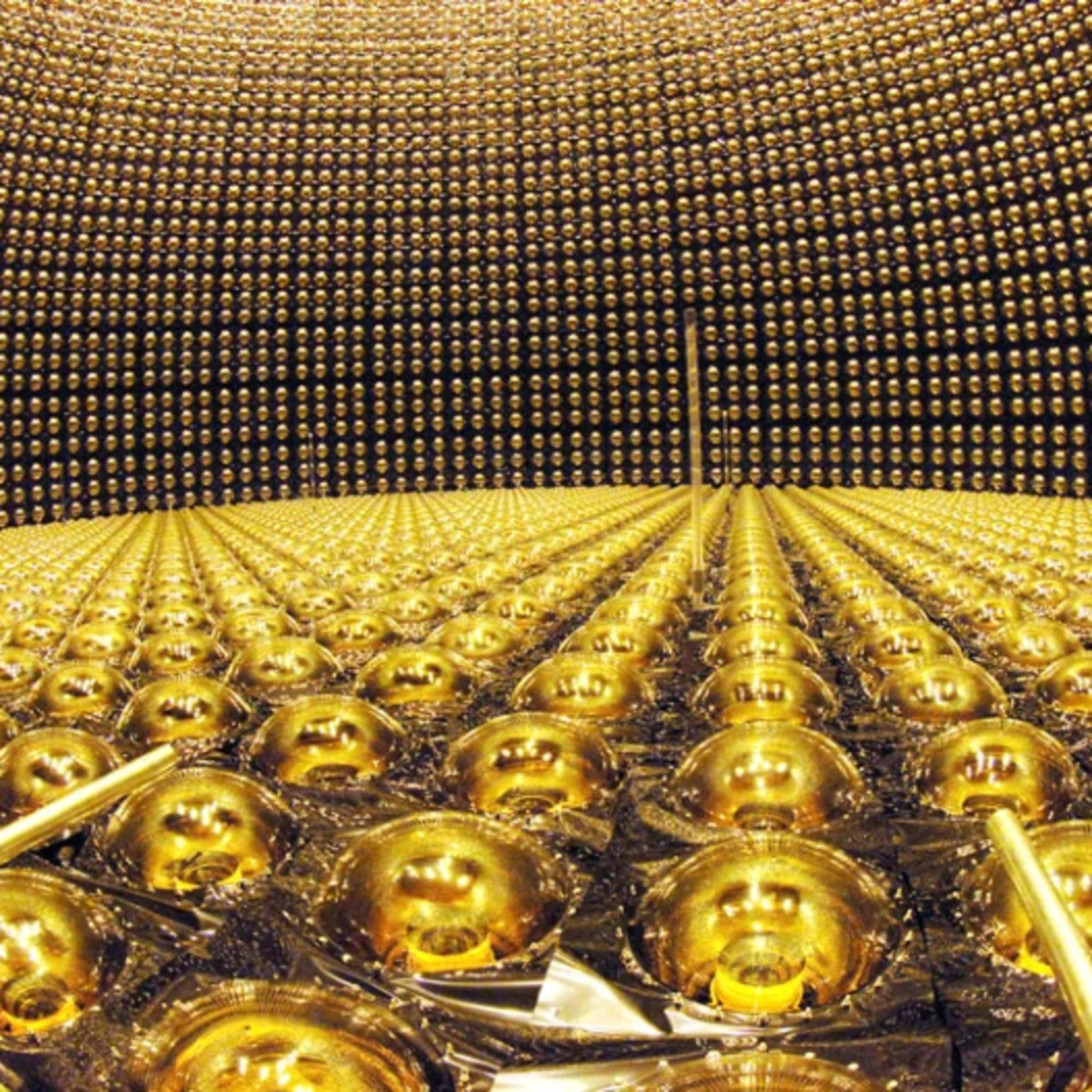
In this episode, we dive into a landmark result from the Super-Kamiokande Collaboration: the first experimental indication (2.6\sigma significance) of electron antineutrinos from the Diffuse Supernova Neutrino Background (DSNB). Also known as supernova relic neutrinos, this faint, steady stream of particles represents the collective glow of every core-collapse supernova that has occurred throughout cosmic history. Key Discussion Points & Highlights: What is the DSNB? Unlike rare burst neutrinos from single local supernovae, the DSNB is a continuous, isotropic flux accumulated from billions of stellar collapses across the observable universe. The 5,000-Day Search: Analyzing 5,003.0 days of data spanning six operational phases between 2008 and 2026 in Japan's underground Super-Kamiokande detector. The Gadolinium Game-Changer: How dissolving gadolinium compound into pure water dramatically boosted delayed neutron tagging efficiency up to ~60–70%, helping researchers suppress atmospheric neutrino and spallation backgrounds. The Main Result: A spectral fit reveals a best-fit flux of 3.6^{+1.6}_{-1.5}\text{ cm}^{-2}\text{ s}^{-1} for neutrino energies E_\nu > 13.3\text{ MeV}, disfavoring the background-only null hypothesis at a 99.5\% confidence level (2.6\sigma). Cosmological & Astrophysical Impact: What measuring this cosmic background teaches us about core-collapse mechanisms, star formation rates, and black hole formation fractions across cosmic time. ### Article Reference Title: Indication of Electron Antineutrinos from the Diffuse Supernova Neutrino Background Authors: K. Abe et al. (Super-Kamiokande Collaboration) Identifier: arXiv:2610.35619v1 [astro-ph.HE] (Dated: October 27, 2026) Acknowledements: Podcast prepared with Google/Gemini Notebook. Illustration credits: The Asahi Shimbun/Getty