Выпуск
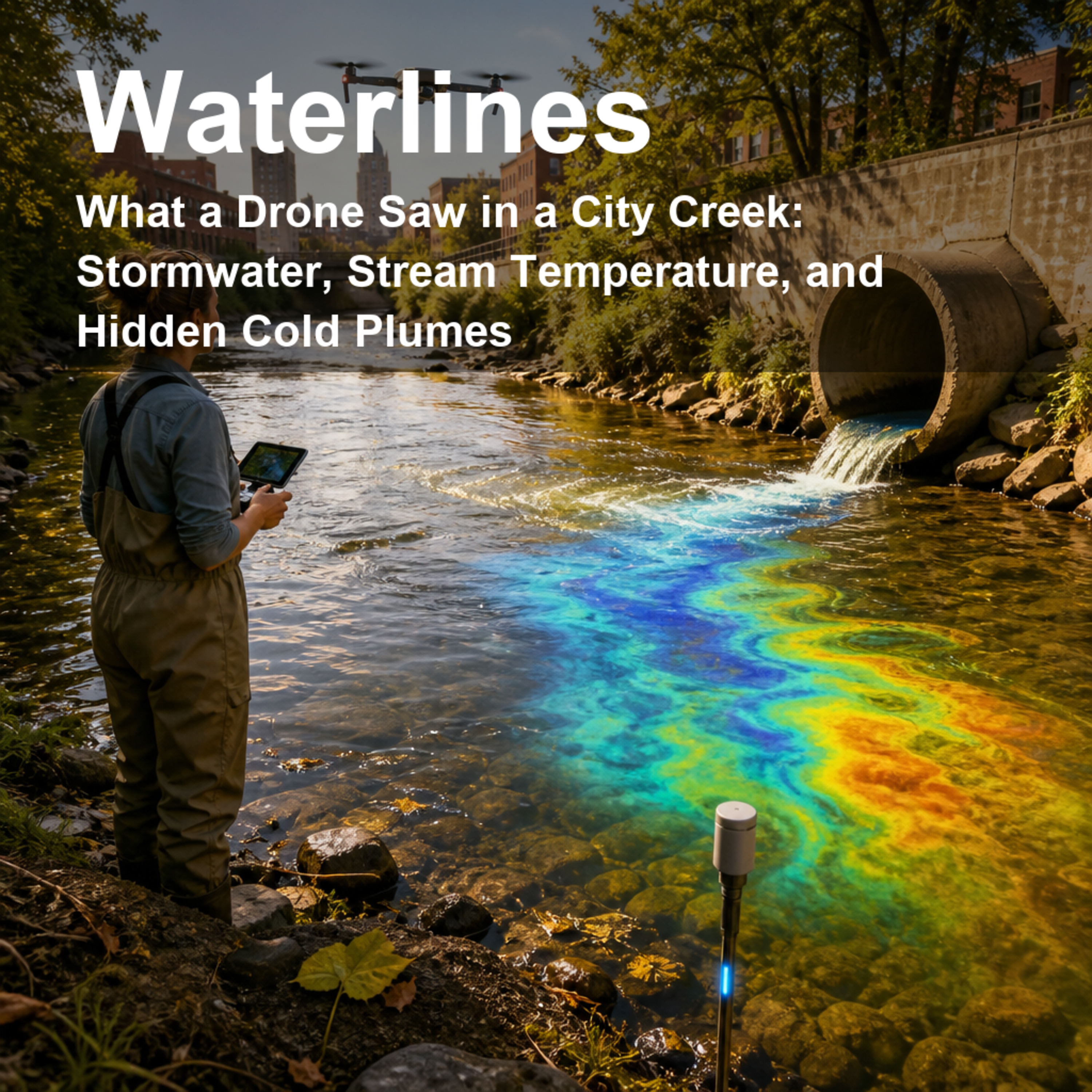
What a Drone Saw in a City Creek: Stormwater, Stream Temperature, and Hidden Cold Plumes
Waterlines: How Water Shapes Our World · 5 ноября 2026 г. · 11 мин
Takeaway: A thin ribbon of stormwater can change a creek’s temperature far downstream, even when a thermometer at one spot would barely notice it. City creeks do more than carry rain away from streets: they carry heat, cold, and clues about how urban infrastructure is changing aquatic life. In this episode, we follow researchers over Onondaga Creek in Syracuse, New York, where small stormwater pipes send narrow plumes into a much larger stream. The surprising part is not just that the water from those pipes can be colder than the creek in late spring and summer, but that a thin plume can travel far enough downstream to matter while occupying only a slice of the channel. We unpack how drone-based thermal infrared imagery, ordinary in-stream temperature sensors, and a physics-based stream temperature model can work together, even when the thermal camera is not accurate enough to be trusted as a simple thermometer. The result is a practical story about monitoring urban water quality, reading streams in two dimensions, and being honest about uncertainty while still learning something useful. Citation: Caldwell, S.H., Kelleher, C., Baker, E.A., & Lautz, L.K. (2019). Relative information from thermal infrared imagery via unoccupied aerial vehicle informs simulations and spatially-distributed assessments of stream temperature. Science of the Total Environment, 661, 364–374. https://doi.org/10.1016/j.scitotenv.2018.12.457 Disclosure: This Waterlines episode uses AI-generated voices for the host conversation.