Выпуск
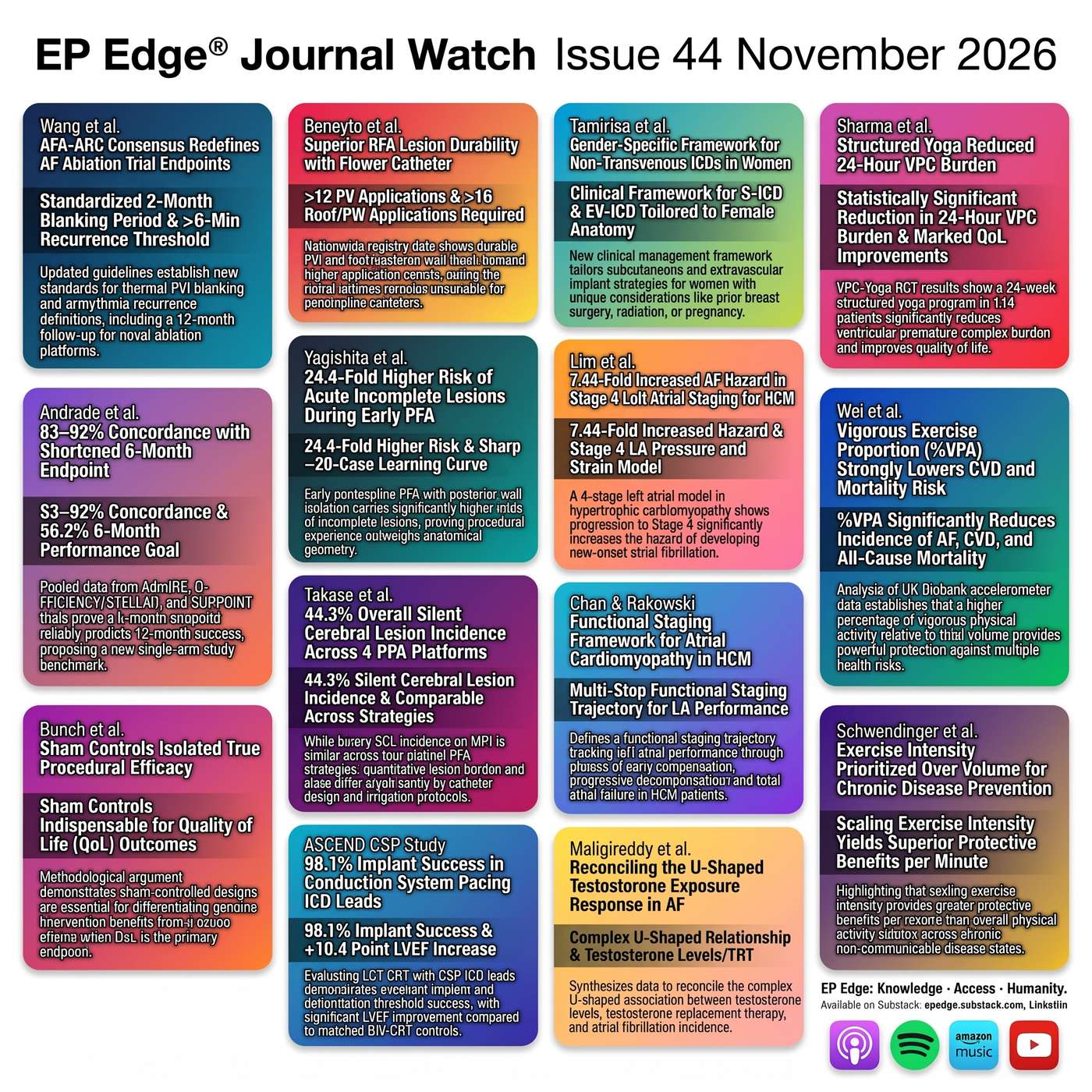
EP Edge® Journal Watch 44, November 2026: AF Ablation Endpoints, Conduction System Pacing and Exercise
EP Edge Journal Watch: Cardiac Electrophysiology Research · 9 ноября 2026 г. · 27 мин
EP Edge® Journal Watch 44, November 2026: AF Ablation Endpoints, Conduction System Pacing and Exercise What should count as successful atrial fibrillation ablation? Can shorter follow-up reliably assess treatment effectiveness? How might conduction system pacing, atrial physiology, and exercise intensity influence the way we evaluate and manage arrhythmia risk? In Issue 44 of EP Edge® Journal Watch, Dr. Sharma examines five featured publications in depth, explaining their rationale, methods, findings, statistical interpretation, limitations, and practical implications. The episode also provides brief assessments of the remaining publications, with comprehensive analyses and infographics available in the newsletter. Designed for electrophysiologists, cardiologists, trainees, and clinicians interested in cardiovascular research, this episode connects the evidence to the decisions it can reasonably inform. FEATURED DISCUSSIONS AF ablation endpoints: why six minutes, and why two months of blanking? Wang and colleagues’ Academic Research Consortium report proposes a framework for evaluating atrial fibrillation ablation effectiveness and safety. We examine the rationale behind the six-minute recurrence threshold, the two-month blanking period, and the distinction between device detection and adjudicated trial outcomes. The discussion also covers AF burden, medication exposure, monitoring intensity, follow-up duration, and safety assessment for emerging technologies. Wang PJ, et al. Atrial Fibrillation Ablation Effectiveness End Points, Safety End Points, and Trial Design: Academic Research Consortium Initiative Endorsed by the Heart Rhythm Society. Circulation: Arrhythmia and Electrophysiology. 2026. DOI: https://doi.org/10.1161/CIRCEP.126.015082 Can six-month outcomes predict twelve-month ablation success? Andrade and colleagues analyze 905 patients from four prospective studies. Agreement between shorter and conventional endpoints was high, but sensitivity for identifying conventional failures ranged from 57% to 76%. We explain why accurate population estimates do not necessarily mean accurate individual classification, and distinguish this six-month total assessment from the consortium’s eight-month recommendation for established technologies in paroxysmal AF. Andrade JG, et al. Incorporating a Shortened Long-Term Effectiveness End Point Into Catheter Ablation Trials: Statistical Properties and Implications. Circulation: Arrhythmia and Electrophysiology. 2026. DOI: https://doi.org/10.1161/CIRCEP.125.014773 Conduction system pacing and defibrillation: what does ASCEND CSP establish? Varma and colleagues evaluate a dedicated conduction system pacing defibrillation lead used with a coronary sinus left ventricular lead. We discuss implantation success, capture, electrical performance, defibrillation testing, and ventricular remodeling. Encouraging findings are considered alongside missing paired imaging, background therapy, and the limitations of comparison with a historical matched cohort. Varma N, et al. Cardiac Resynchronization Therapy Using a Conduction System Pacing Defibrillation Lead in Patients Meeting CRT-D Indications: Six-Month Clinical Outcomes Results From the ASCEND CSP Study. JACC: Clinical Electrophysiology. 2026. DOI: https://doi.org/10.1016/j.jacep.2026.10.003 Hypertrophic cardiomyopathy: looking beyond left atrial size Lim and colleagues combine estimated atrial pressure and contractile function to characterize future AF risk. We explain the physiological stages, the increasing incidence of AF, external validation, and the incremental imp