Выпуск
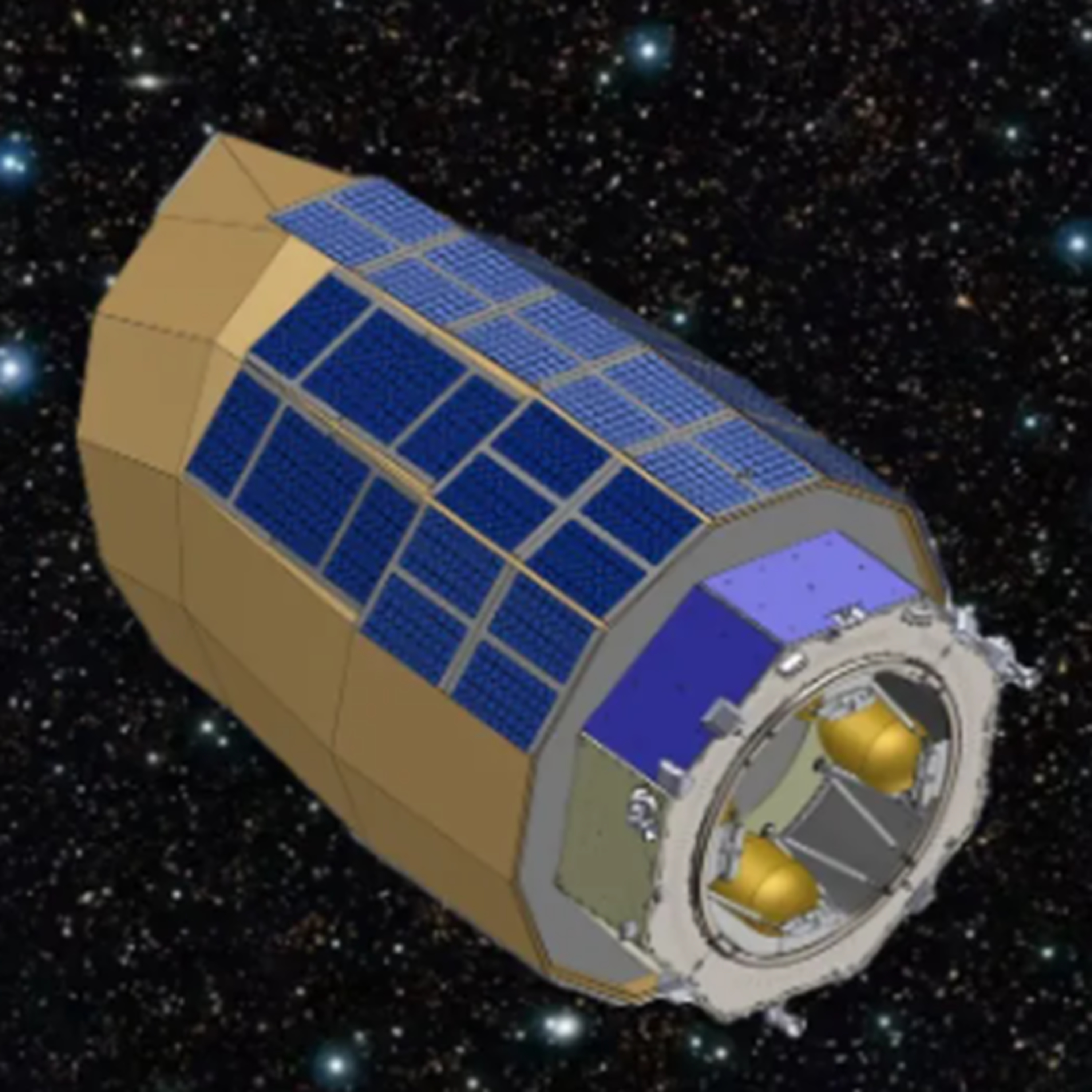
The Lazuli Space Observatory: Time-Domain Astronomy’s Next Flagship
Multi-messenger astrophysics · 9 ноября 2026 г. · 23 мин
In this episode, we dive into the Lazuli Space Observatory , a flagship space mission designed to fill the critical gap in tracking faint, fast-evolving cosmic transients. Featuring a 3-meter primary mirror in a 3:1 lunar resonant orbit, Lazuli combines flagship-class sensitivity with an ultra-fast target-of-opportunity (ToO) response time of less than 4 hours (and under 90 minutes in favorable scenarios)—one to two orders of magnitude faster than conventional space telescopes like Hubble or JWST. We explore how Lazuli will revolutionize our understanding of gravitational wave counterparts, exploding stars, black holes, and the expansion of the universe. Key Discussion Points & Highlights The Latency Bottleneck in Astronomy: Why ground telescopes are limited by day-night cycles and why existing space observatories take days to respond to transient alerts. Observatory Architecture: Lazuli’s 3m off-axis telescope, equipped with the Wide-field Context Camera (WCC) for broadband and narrowband imaging and an Integral Field Spectrograph (IFS) spanning 0.4–1.7 µm. Chasing Gravitational Wave Counterparts: Following up kilonovae from neutron star mergers detected during LIGO/Virgo/KAGRA’s O5 run and identifying heavy r-process element synthesis like strontium and yttrium. Fast Transients & Supernovae: Probing mysterious Fast Blue Optical Transients (FBOTs) such as AT2018cow, obtaining "flash spectroscopy" of young core-collapse supernovae within hours of explosion, and analyzing high-redshift Tidal Disruption Events (TDEs). Cosmology & Galactic Astrophysics: Measuring the Hubble constant (H_0) through strongly lensed supernovae and standard sirens, while conducting high-precision astrometry and period mapping for ultracompact binaries in our own Galaxy. Title: The Lazuli Space Observatory: Opportunities for Time-domain and Multi-messenger Astronomy Authors: Thomas Wevers, Thomas J. Maccarone, Antonella Palmese, David J. Sand, Suvi Gezari, Liliana Rivera Sandoval, John DiPalma, Griffin Hosseinzadeh, Taylor J. Hoyt, Mitchell Karmen, Jamie Kennea, Keerthi Kunnumkai, Saul Perlmutter, Mickael Rigault, Arpita Roy, Gudmundur Stefansson, and Fan Yang Yang Journal: Publications of the Astronomical Society of the Pacific (PASP), Vol. 138, Art. 105003 (2026) DOI: [10.1088/1538-3873/aeaf84](https://doi.org/10.1088/1538-3873/aeaf84) Acknowledements: Podcast prepared with Google/Gemini Notebook. Illustration credits: Schmidt Sciences